

Summary of 2025; What is next?
Originally published on LinkedIn: December 15, 2025
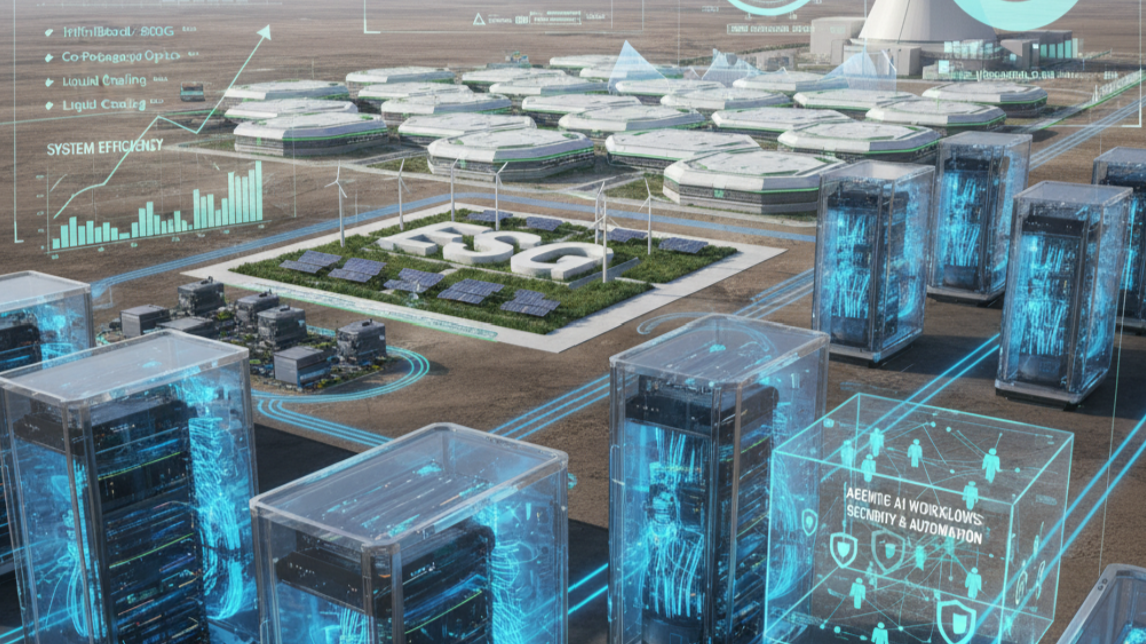
AI in 2025: Infrastructure, Efficiency, and Enterprise Reality The defining story of AI in 2025 wasn’t about which lab released the biggest model or what consumer chatbot went viral—it was about infrastructure maturity and operational discipline. The industry’s obsession shifted from raw GPU counts to system-level efficiency, as hyperscalers and enterprises alike confronted hard questions about power consumption, networking bottlenecks, and actual return on capital deployed. Nvidia remained supply-constrained on high-memory SKUs while production clusters optimized around H100 and B200 systems, but the real action happened in networking and cooling infrastructure. InfiniBand and 800G Ethernet became critical chokepoints, with emerging optical circuit switching and co-packaged optics architectures promising to reduce power draw and switch complexity. Immersion cooling and liquid loops transitioned from experimental curiosities to table stakes for dense AI racks, driven as much by sustainability pressure as thermal requirements. Meanwhile, AMD’s MI300 chips quietly gained traction in HPC-adjacent workloads where memory bandwidth and cost efficiency mattered more. Model development in 2025 followed a path of incremental refinement rather than revolutionary leaps. OpenAI, Google, and Anthropic delivered meaningful but measured improvements focused on longer context windows, more reliable tool use, and better reasoning capabilities—not headline-grabbing parameter increases. Internal benchmarks shifted away from academic metrics toward agent reliability and multi-step task completion, reflecting where actual business value was being generated. Open-weight models continued closing the capability gap for enterprise use cases, particularly when combined with robust retrieval-augmented generation and guardrails, making fine-tuned smaller models on accessible hardware a viable alternative to expensive frontier API calls. The conversation evolved from “how big can we make this model” to “how efficiently can we deploy something that actually works,” with training recipe optimization, context window engineering, and agent workflow design mattering more than parameter counts. This pragmatic turn reflected a maturing industry where capital discipline returned and CFOs demanded utilization metrics, power efficiency data, and clear networking ROI before approving infrastructure expansion. Enterprise adoption crystallized around a single, transformative trend: agentic AI moving from demonstration environments into production systems. Real deployment happened not in consumer chat applications but in workflow automation, security operations, IT operations, and data engineering pipelines—precisely where latency, determinism, and auditability mattered more than creative flair. Organizations deployed language models into extended detection and response systems, identity and access management platforms, and security operations centers, creating autonomous agents that could take meaningful actions within production environments. Yet this operational transition exposed critical security challenges that couldn’t be addressed with traditional approaches. The risk wasn’t the models themselves, but the autonomy layered on top —the expanded permissions, automated decisions, and new attack vectors through prompt injection and data exfiltration. Identity and access management, zero-trust network architecture, and adversarial-resistant guardrails evolved from optional security enhancements into architectural requirements, especially in regulated environments where compliance failures carried existential consequences. By year’s end, several fundamental trends had emerged that will shape AI’s trajectory into 2026 and beyond. Scaling is no longer just about GPU procurement—power provisioning, optical interconnects, memory architecture, and network topology now dominate both performance and cost structures. Efficiency beats raw scale consistently, as teams optimizing batch sizing, interconnects, and model architecture outperform competitors with larger but less thoughtfully configured infrastructure. The AI stack has fragmented intentionally, with best-in-class deployments mixing GPUs, CPUs, domain-specific accelerators, vector databases, and advanced optics rather than on monolithic platforms. Most importantly, 2025 established that security and control must be designed into AI systems from inception, guardrails, access control, and adversarial testing are now first engineering requirements priorities. The year proved that AI’s next phase won’t be defined by which lab trains the largest model, but by which organizations can deploy reliable, auditable, identity-aware agents inside real systems at scale.