

The data center of the Future (2035)
Originally published on LinkedIn: May 29, 2025
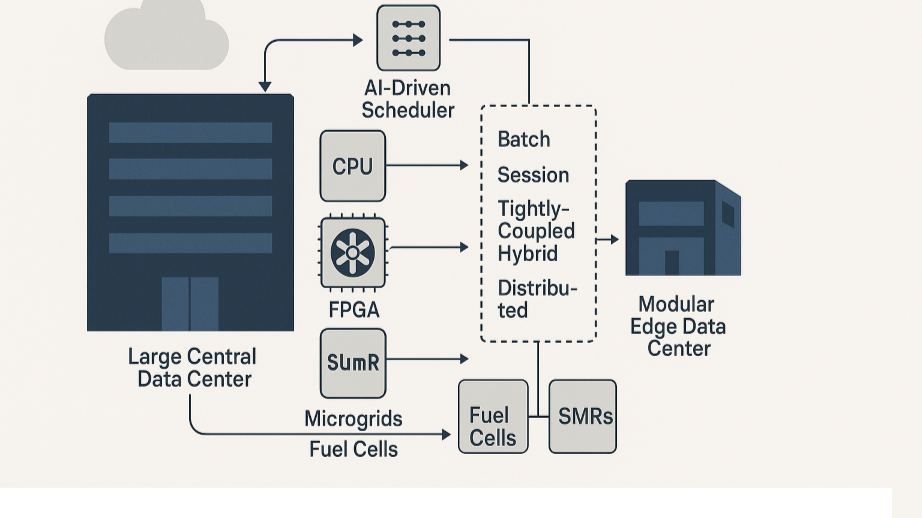
1 | Hybrid stays the foundation aka “Hybrid Data Centers” Over the next decade I expect large central data centers and modular edge data centers to operate as one fabric, their capacity steered by AI agents that weigh cost, latency, carbon, and policy. Microsoft already exposes four execution modes—batch, session, tightly-coupled hybrid, and distributed—so the scheduler can assign a task to a CPU, an X-series GPU, an FPGA, or a quantum processor without human intervention. Power resilience shifts in step: on-site microgrids, solid-oxide fuel cells, and small modular reactors (SMRs) offset grid limitations and steady the 80–150 MW clusters that next-generation accelerators demand. The result is a single operational surface that scales from regional megawatt estates to kilowatt edge pods while keeping sustainability targets in view. 2 | Quantum extends, never replaces A logical qubit—the error-corrected unit programmers use—still needs hundreds of noisy physical qubits plus continuous correction inside an ultra-cold cryostat held near 10 millikelvin. Trapped-ion systems from Quantinuum, superconducting circuits from Rigetti, neutral-atom arrays from Willow, and upcoming topological approaches all sit behind Azure Quantum’s broker, appearing to software as specialised co-processors rather than data-center replacements. Classical controllers shape laser or microwave pulses, capture read-outs, and feed optimisation loops, so quantum hardware augments the stack; it does not displace GPUs or CPUs. 3 | Classical silicon keeps pace and pairs with quantum CPUs, DPUs, and the coming GPU generation raise throughput with stacked HBM and on- package photonics. Current hybrid workflows already call on roughly ten classical processors for every quantum unit, managing data preparation, parameter sweeps, and result analysis. That ratio widens as logical-qubit counts grow and feedback budgets tighten below ten microseconds. Locating a subset of classical nodes in the same modular edge data center as the quantum rack keeps latency under control, while heavy model training or analytics stay in the central facility—both powered by the same microgrid. 4 | Architecture evolves, orchestration decides Quantum bays require vibration isolation, RF shielding, and cryogenic refrigeration; immersion- cooled GPU aisles push 100 kW per rack and feed waste-heat recovery loops. These elements package into repeatable modules that colocation providers can deploy worldwide without discarding existing electrical or security infrastructure. Above the hardware, Azure Quantum, AWS Braket, and comparable platforms offer identity, compliance, and multi-tenant queueing. Their policy engines let AI agents rebalance work across classical and quantum hardware in real time when qubit coherence drifts or GPU queues clear. By 2035, value flows less from owning any single chip and more from orchestrating diverse accelerators securely, sustainably, and at global scale.