
Next-Generation AI Knowledge Retrieval: Beyond LightRAG
Originally published on LinkedIn: January 2, 2026
LightRAG: The Efficiency Pioneer
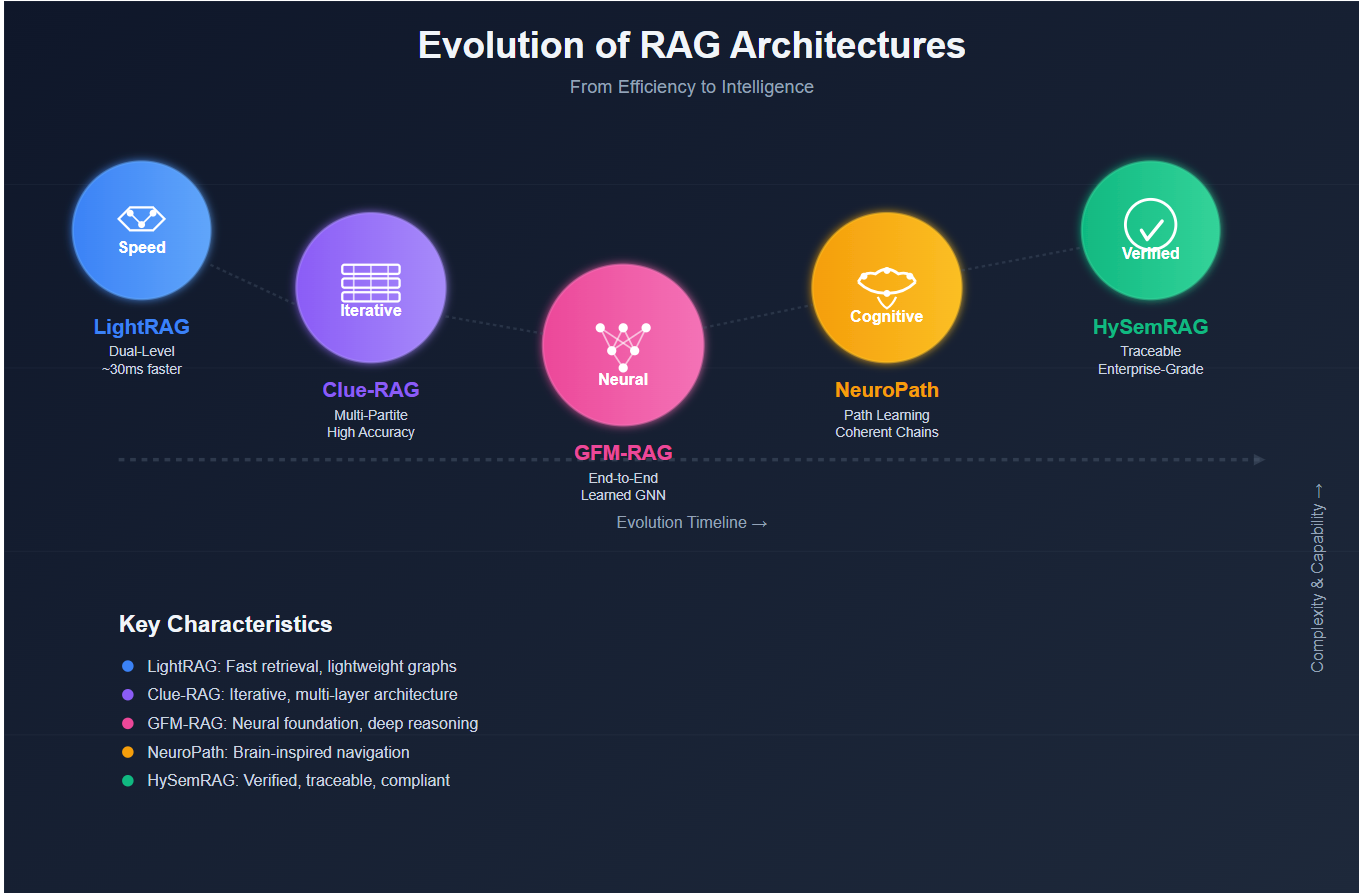
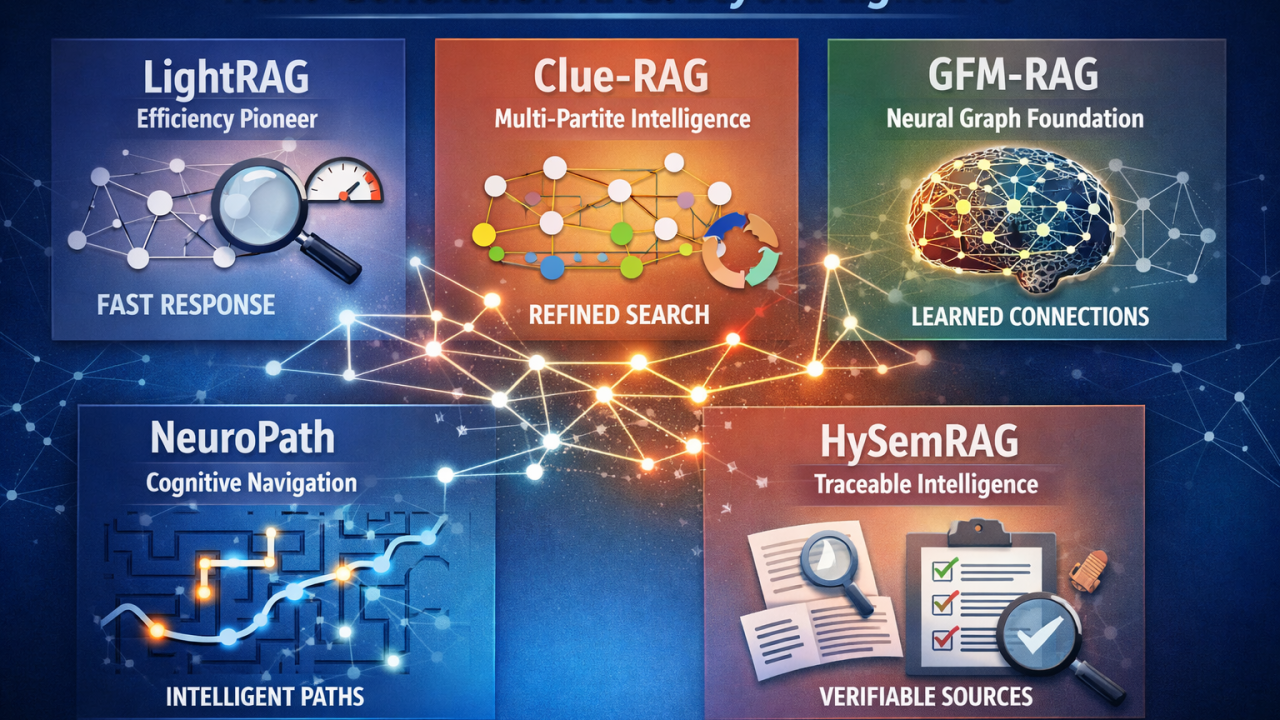
LightRAG represents the first major evolution beyond traditional vector- based retrieval, introducing a dual-level system that combines semantic search with lightweight graph structures. In simple terms, it mixes “meaning-based search” with basic relationships between entities to improve relevance. It constructs small knowledge graphs from text and retrieves results using both exact matches and thematic similarity. This design delivers very fast responses (often tens of milliseconds faster than classic RAG), making it ideal for real-time copilots and dashboards. However, because the graph is shallow, LightRAG struggles when questions require deep relationships or long chains of cause and effect.Clue-RAG: Multi-Partite Intelligence
Clue-RAG advances beyond LightRAG by separating entities (things like people, systems, products) from semantic meaning (topics and concepts) into a richer multi-partite graph. Instead of searching once, it refines retrieval step by step, learning what the question is really asking. This reduces missed context and improves accuracy without heavy graph traversal. Graph structure and semantic search work together, not side by side, enabling clearer multi-hop reasoning. Clue-RAG is well suited for enterprise analytics and structured business data, where correctness matters more than raw speed.GFM-RAG: The Neural Graph Foundation
GFM-RAG represents a major shift from manually built graphs to neural graphs learned end-to-end. Instead of engineers defining relationships, the model learns which connections matter during training. This enables true multi-hop reasoning that generalizes to new domains without rebuilding graphs. The system outperforms traditional graph RAG on complex question-answering tasks by learning how relationships impact answer quality. Today, it remains research-grade and difficult to operate in production, but it signals where deep reasoning RAG systems are heading.NeuroPath: Cognitive Navigation for Knowledge Graphs
NeuroPath changes how systems move through graphs by learning good reasoning paths, rather than following fixed rules or shortest paths. Inspired by how humans navigate knowledge, it keeps context across long reasoning chains and avoids pulling in loosely related information. This leads to higher recall, tighter relevance, and lower token usage. Instead of “searching everything connected,” it follows paths that make semantic sense. NeuroPath is still experimental, but it is promising for causal analysis and investigations requiring sustained reasoning.HySemRAG: Traceable Enterprise Intelligence
HySemRAG is designed for enterprises that need answers they can prove and audit. It combines semantic search, graph grounding, and agent-like self-checking to ensure every claim is traceable to a source. Unlike speed- focused systems, it prioritizes correctness, explainability, and citation validation. This makes it ideal for healthcare, finance, legal, and compliance use cases. While slower than simpler RAG systems, HySemRAG delivers the reliability required when decisions have regulatory or financial impact.