
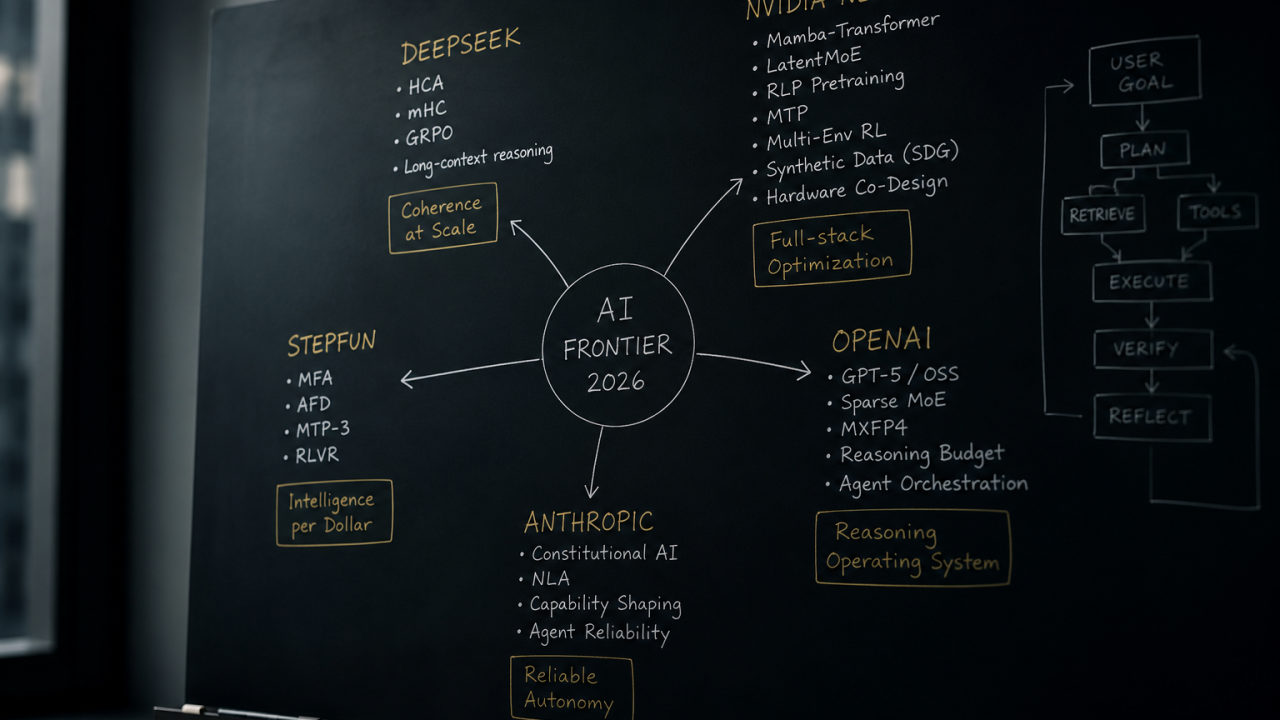

Frontier Model Architecture Comparison (2026) (Nemotron, DeepSeek, OpenAI, StepFun, Anthropic)
Originally published on LinkedIn: June 1, 2026
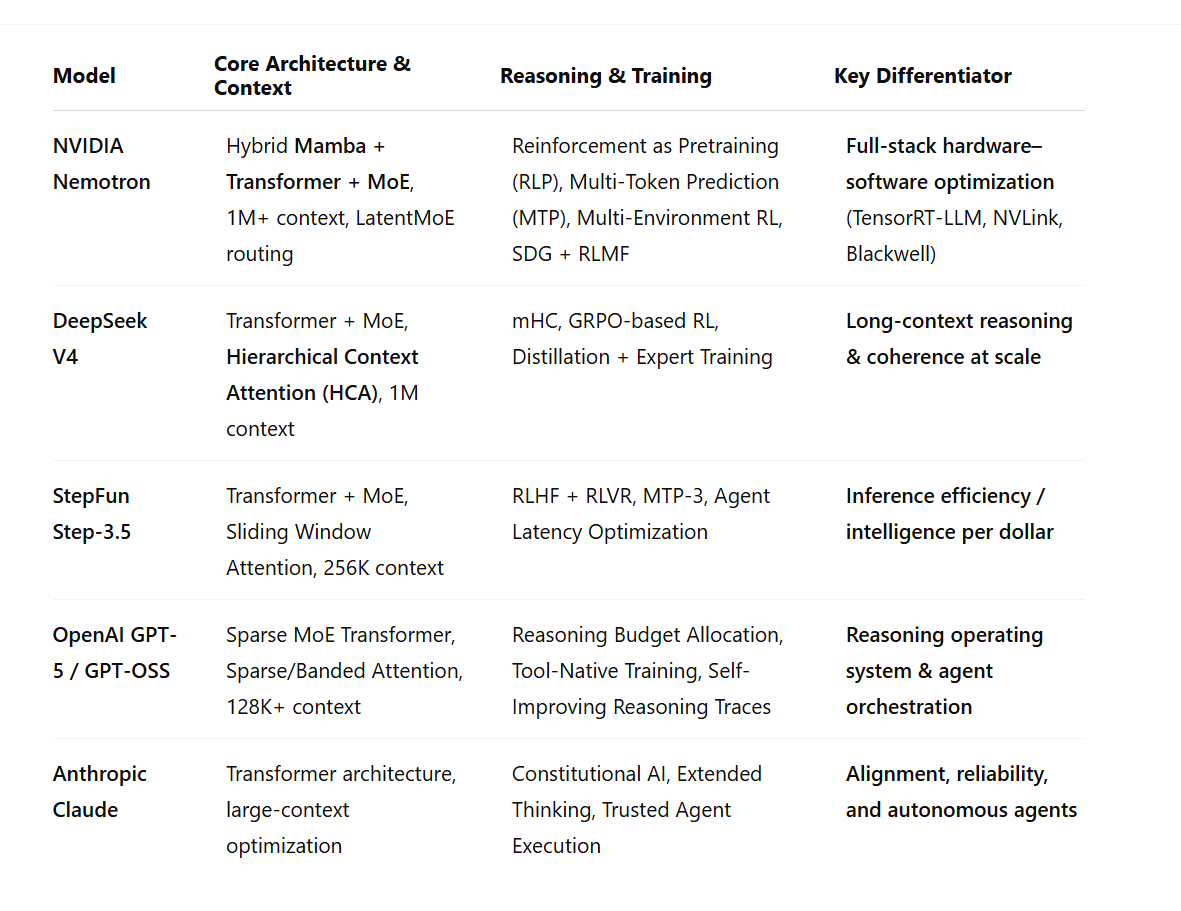
(Nemotron, DeepSeek, OpenAI, StepFun, Anthropic)” />
Key Architectural Innovations (Key techniques explained below)
Core Techniques Explained that differentiate Frontier Models
Mamba State Space Model (SSM): Mamba replaces attention with a recurrent state-space mechanism that compresses historical information into a fixed-size state vector. Memory consumption grows much more slowly than Transformer attention, making million-token contexts practical.
Mixture of Experts (MoE): Instead of activating the entire model for every token, a router selects a small number of specialized experts. This increases total model capacity while keeping inference cost manageable.
LatentMoE: An evolution of MoE routing. Tokens are first projected into a latent semantic space before expert selection. The router therefore chooses experts based on higher-level semantic intent rather than raw token embeddings.
Hierarchical Context Attention (HCA): DeepSeek’s approach to long- context reasoning. The model creates local, regional, and global summaries of information and attends to compressed representations rather than every token individually.
Manifold-Constrained Hyper Connections (mHC): A replacement for traditional residual connections. Multiple information pathways preserve different reasoning signals independently while maintaining training stability in very deep networks.
Multi-Matrix Factorization Attention (MFA): StepFun’s attention optimization technique. Large attention matrices are decomposed into smaller matrix operations to reduce memory movement and increase GPU utilization.
Attention-FFN Disaggregation (AFD): Separates attention workloads from feed-forward network workloads. Memory-bound and compute-bound operations are optimized independently, improving accelerator efficiency.
Multi-Token Prediction (MTP): Instead of predicting a single future token, the model predicts multiple future tokens simultaneously. This reduces decoding latency and increases token throughput.
Reinforcement as Pretraining (RLP): Introduced by NVIDIA. Reasoning is incorporated directly into pretraining rather than being added later through post-training reinforcement learning. The model learns reasoning behaviors while learning language.
Group Relative Policy Optimization (GRPO): A reinforcement learning approach used heavily by DeepSeek. Multiple candidate responses are compared against one another instead of relying on a separate reward model.
Reinforcement Learning with Verifiable Rewards (RLVR): Uses objectively measurable outcomes such as correct code execution, mathematical correctness, or benchmark verification to generate reward signals.
Constitutional AI: Anthropic’s alignment framework. The model is trained against a written set of principles and learns to critique and revise its own outputs based on those principles.
Reasoning Budget Allocation: OpenAI’s dynamic inference approach. The system adjusts the amount of compute, planning depth, and reasoning tokens based on task complexity.
Synthetic Data Generation (SDG): Large teacher models generate new training examples, reasoning traces, and instruction datasets that are verified before being used to train future model generations.
Reinforcement Learning from Model Feedback (RLMF): A synthetic-data training loop where a model generates outputs, a verifier model evaluates quality, and approved outputs become training data for subsequent models.
MXFP4 / NVFP4: Ulra-low precision floating-point formats optimized for inference. They reduce memory bandwidth requirements while preserving model quality through hardware-aware training and quantization.